








Click the photo to view the full-size version
| Name | C&NW Milwaukee River Bridge Chicago & North Western Railway Bridge #1556 |
| Built By | Chicago & North Western Railway |
| Currently Owned By | City of Milwaukee (East Approach) Union Pacific Railroad (Main Span and West Approach) |
| Superstructure Contractor | American Bridge Company of New York (Main Span) Unknown (Approach Spans) |
| Substructure Contractor | Cleary-White Construction Company of Chicago, Illinois (Center Piers) Unknown (Approach Substructures) |
| Erection Contractor | Bernhisel Construction Company of Chicago, Illinois (Erecting Span) Great Lakes Dredge & Dock Company of Chicago, Illinois (Moving Span) |
| Design Engineer | William H. Finley |
| Length | 403 Feet Total, 242 Foot Main Span |
| Width | 2 Tracks |
| Height Above Ground | 15 Feet (Estimated) |
| Superstructure Design | Quadrangular Lattice Through Truss Swing Span and Steel Stringer |
| Substructure Design | Concrete and Steel Pile |
| Date Built | 1915, Approaches Added c. 1935 |
| Traffic Count | 0 Trains/Day (Bridge is Open to Pedestrian Traffic) |
| Current Status | Abandoned, East Approach Reused as Pedestrian Walkway |
| Chicago & North Western Railway Bridge Number | 1556 |
| Union Pacific Railroad Bridge Number | 83.52 |
| Significance | Regional Significance |
| Documentation Date | 6/13/2014; 5/7/2022 |
In the early 1850s, several railroad companies began constructing
railroad lines radiating from Chicago. In 1855, the Chicago & Milwaukee Railroad (C&M) constructed a
45-mile railroad line, extending north from an existing railroad line at
Ashland Avenue and Armitage Avenue in Chicago to the Wisconsin State Line near
Kenosha. At the same time, the Milwaukee & Chicago Railroad (M&C) constructed an additional 40 miles north to Milwaukee. The two railroads would be consolidated into a new railroad known as the Chicago & Milwaukee Railroad (C&M) soon after completion, and would come under control of the Chicago & North Western Railway (C&NW) in 1866. The C&M was leased to the Chicago, Milwaukee and North Western Railway (CM&NW) in 1883. The C&NW acquired control of the CM&NW soon after. The C&NW had constructed and acquired a large network of railroad lines through the Midwest. This line formed a portion of the
principal north mainline of the C&NW, eventually extending to northern Wisconsin and the Upper Peninsula of Michigan. Due to increasing traffic
along this line, a second track would be constructed between 1890 and 1892.
View historic articles discussing the construction of this bridge (digitalized by Google)
Located near Erie Street in Milwaukee, this large through truss swing bridge carries the former Chicago & North Western Railway mainline over the Milwaukee River. The first bridge at this location was likely a single track wooden swing span, constructed when the line was first built. In the mid-1870s or early 1880s, the original bridge was replaced by a single track iron through truss swing bridge. In 1890, a new double track iron swing bridge was installed on a new stone center pier. The old bridge was sold to the Kewaunee, Green Bay & Western Railroad for use as a jointly owned bridge at Green Bay, Wisconsin. This bridge consisted of an 11-panel, pin-connected Pratt through truss, designed as a rim-bearing swing span. Typical of bridges from this era, this span used a combination of built-up members, eyebars and lattice portal bracing. By the early 20th Century, this bridge has become too light for traffic, and replacement plans were made. A swing bridge design was chosen for the replacement, as it could be constructed without requiring a new permit from the government.
Work on the new bridge began in late 1914, when the old bridge was floated approximately 60 feet downstream and placed on temporary timber substructures. By moving the bridge, this allowed a new bridge to be constructed at the same location without interrupting traffic. To facilitate the construction of the new substructures, the original stone pier and abutments were removed to below the water line, and new concrete substructures were constructed above the water line. On Sunday, March 14 1915, the new bridge was floated into place and the old bridge removed from service and scrapped. All work on the new bridge was done under William H. Finley; Chief Engineer of the Chicago & North Western Railway and W.C. Armstrong, Bridge Engineer. American Bridge Company fabricated the steel for the superstructure, while the Cleary-White Construction Company constructed the new substructures. Bernhisel Construction Company was contracted to erect the new bridge, and the Great Lakes Dredge & Dock Company handled moving the spans. Initially, the bridge was approached by timber pile trestle spans on either end. In approximately 1935, these spans were replaced with steel stringer spans, giving the bridge its present configuration.
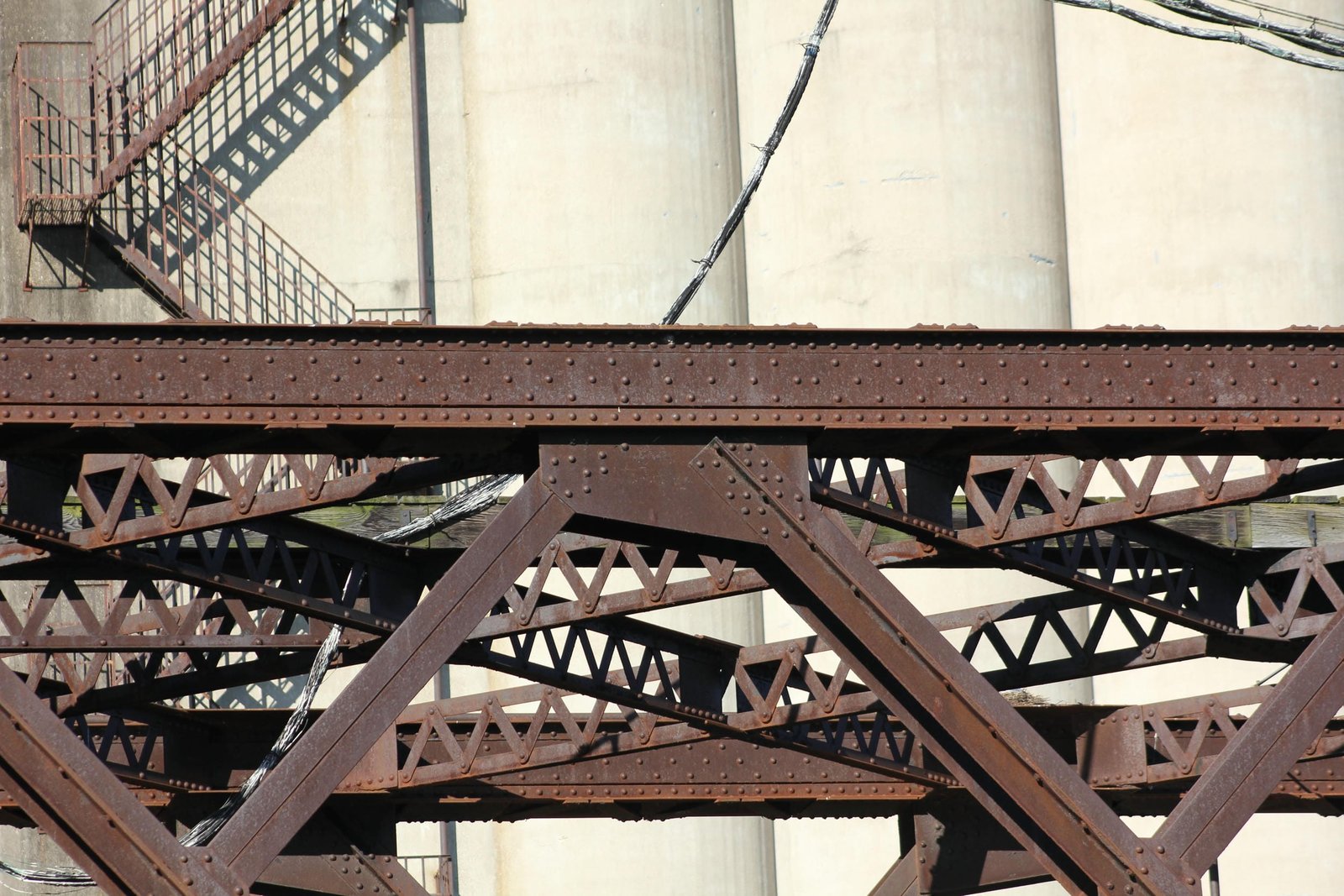
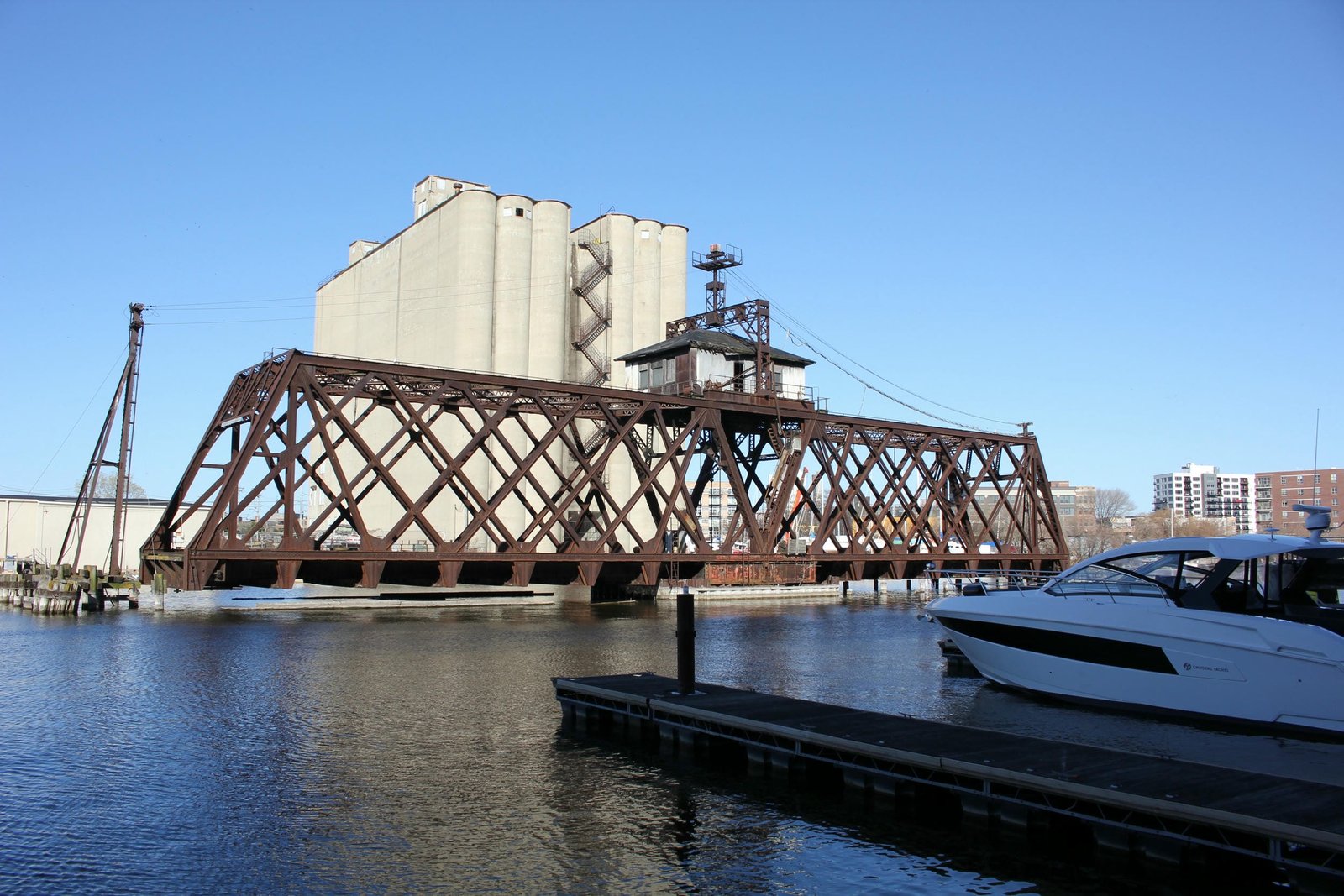
Currently, the bridge consists of a 242-foot, double track riveted quadrangular lattice through truss swing span, approached by five 23-foot steel stringer spans on the east end and two 23-foot steel stringer spans on the west end. The center pier and adjacent piers are constructed of concrete, while the approach piers are composed of steel piles and transverse steel girders. Similar to the previous structure, the swing span uses a rim-bearing design, where the superstructure is set onto a steel drum, which rotates about a roller nest and is driven by a gear system. Typical of through truss spans constructed during this era, the swing span is heavily constructed, using large members and a heavy floor system. The span is composed of two equal halves, which are joined at the center by a pair of endposts, creating an unusual geometry. Unlike many swing spans, this bridge does not use a tower, and instead the center is formed from a large inverted triangle. The top chord and endposts both consist of heavily built-up beams, with a solid plate on the outside and V-lacing on the inside. The bottom chord is composed of a built-up beam, which is connected by thin steel plates. All of the diagonal members are constructed out of rolled beams, an unusual feature of this bridge. The floor system is constructed out of plate girder floorbeams and stringers, and the floorbeams are held to the bottom chord by large trapezoidal plates. Similar to many other C&NW trusses from the early 20th Century, the portal bracings are composed of an M-frame design, which is constructed out of V-laced beams. The sway bracing and upper lateral bracing is also constructed of V-laced beams.
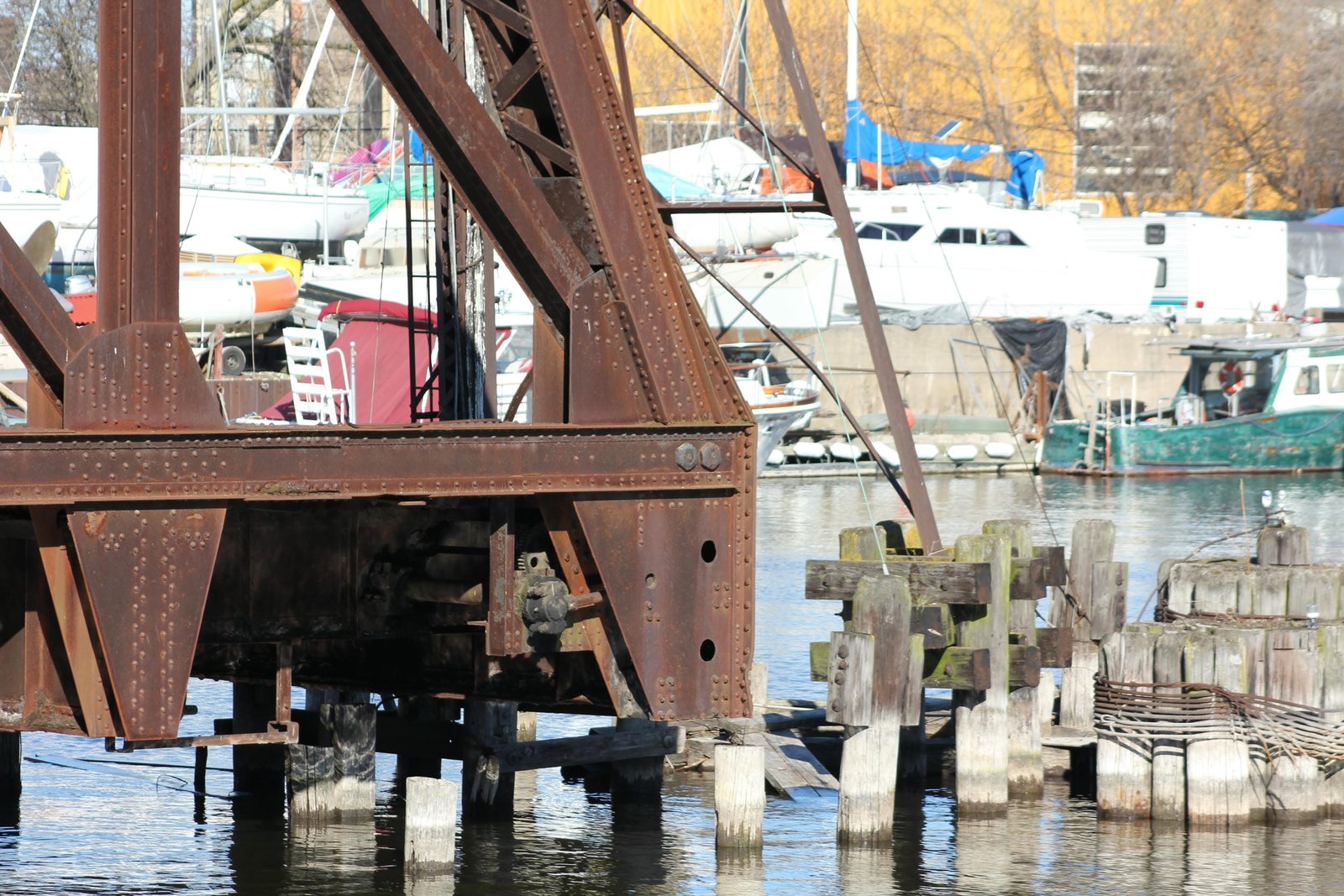
All of the operating machienry of the bridge remains intact, including the central gears and rollers, the end lifts and the locking mechanisms. A wooden machinery house is located over the center of the span, and a large electrical bridge has been placed over the house. This electrical bridge uses a similar design to signal bridges constructed for the C&NW in the early 20th Century. Railroad records indicate that the bridge was electrified in 1930. The drum that the span is set onto uses a square shape, which was preferred by the C&NW. The approach spans use a standard design for the era, with heavy rolled I-beams. The outside concrete piers use a rectangular shape, while the center pier uses a round shape. The approach piers consist of three round steel piles on each side of the bridge, which are covered by a larger steel plate. These steel plates are connected by a transverse plate girder, a design typically used by the C&NW. The eastern end of the east approach is slightly flared, which was to accommodate a switch and side track which left the mainline. In addition, an attractive brick interlocking tower was located at the east end of the bridge to control switching operations in the area. This tower is now privately owned, and has been partially restored.
This type of truss design is relatively uncommon throughout the United States. However, a few railroads preferred the design, such as the Chicago, Rock Island & Pacific Railway (Rock Island), the Chicago & North Western Railway (C&NW) and the Omaha Road. Spans constructed in the late 1870s and early 1880s for the C&NW featured an arched and pedimented lattice portal bracing, light sway bracing and laced members. The second generation was nearly exclusively constructed by Lassig Bridge & Iron Works between 1884 and 1900, and featured heavier members and a pedimented portal bracing. While the design fell out of favor for the Rock Island and Omaha Road around the turn of the 20th Century, the design remained popular with the C&NW into the 1920s. 19th Century versions of this design were primarily constructed out of iron, while 20th Century versions of this design used much heavier members and were constructed of steel. The C&NW preferred this design, as it was both strong and demonstrated great resilience in case of a derailment. Relatively few swing spans were ever constructed using this design.
In the late 20th Century, the northern track was removed from the bridge. After the removal of the passenger depot in Milwaukee, traffic over this bridge was limited to mainly industrial switching operations. The last use of the bridge came in 2003, and the bridge was abandoned soon after. To prevent obstructions to river navigation, the bridge has been rotated into open position since. In 2018, a pedestrian deck was added to the east approach of the bridge. Various proposals have been made for the City to acquire the remainder of the bridge and reuse the structure. One proposal includes converting the swing span to an events space and gathering spot which regularly rotates. Another proposal included keeping the swing span in open position and installing retractable pedestrian bridges to reach it. The bridge is currently considered a City of Milwaukee landmark. Overall, the bridge appears to be in fair to good condition, with no significant deterioration noted. Sheet metal protection has been added around the center pier to help stabilize the structure. The author has ranked this bridge as being regionally significant, due to the swing span design and landmark status.
Citations
| Builders and build date (main span) | Railway Age Gazette; Volume 58, Issue 16 |
| Railroad History Citation | ICC Valuation Information, Compiled by Richard S. Steele |