







Click the photo to view the full-size version
| Name | Gotch Park Trail Bridge Minneapolis & St. Louis Railway Bridge #136 |
| Built By | Minneapolis & St. Louis Railway |
| Currently Owned By | Humboldt County Conservation Board |
| Superstructure Contractor | Detroit Bridge & Iron Works of Detroit, Michigan |
| Substructure Contractor | Unknown |
| Length | 336 Feet Tota, 159 Foot Main Span |
| Width | 1 Track |
| Height Above Ground | 15 Feet (Estimated) |
| Superstructure Design | Pratt Through Truss and Timber Pile Trestle |
| Substructure Design | Stone Masonry and Timber Pile |
| Date Built | 1901 |
| Traffic Count | 0 Trains/Day (Bridge is Open to Pedestrian Traffic) |
| Current Status | Open to Pedestrian Traffic |
| Minneapolis & St. Louis Railway Bridge Number | 136 |
| Significance | Moderate Significance |
| Documentation Date | 8/12/2013 |
In 1877, the Fort Dodge & Fort Ridgeley Railroad Company (FD&FR) began construction of a 16-mile railroad line, extending from Livermore, Iowa to Humboldt, Iowa. After several delays, work on the line was completed in 1879. In 1879, the FD&FR constructed an additional 13 miles of new railroad from Humboldt to Fort Dodge, Iowa. At the same time, the Minnesota and Iowa Southern Railway (M&IS) began construction on a 60-mile railroad line, extending from the Minnesota/Iowa State Line towards Livermore, Iowa. The same year, the Minneapolis & St. Louis Railway (M&StL) constructed 13 miles of new railroad, extending from Albert Lea, Minnesota to the State Line. Both the M&IS and M&StL segments were completed in late 1880. The FD&FR and M&IS were consolidated into the M&StL in 1881, which was reorganized as the Minneapolis & St. Louis Railroad (M&StL) in 1895. This line served as a secondary mainline for the M&StL, and provided connections to Des Moines, Iowa and other branch lines. To reach the other M&StL line at Tara, Iowa; the M&StL utilized trackage rights over the Illinois Central Railroad (IC) between Fort Dodge and Tara.
The M&StL was a small midwestern railroad, connecting Minneapolis, Minnesota to Peoria, Illinois. The M&StL mainly served as a bridge railroad, allowing eastern and western railroads to interchange while bypassing the congested terminals at Chicago. Secondary lines and branch lines primarily served agricultural industries. Because the M&StL had light freight density and limited passenger service, the railroad survived on razor thin margins and often was in financial stress. The M&StL would later reorganize as the Minneapolis & St. Louis Railway in approximately 1920. Through the 1930s, the railroad focused on trimming excess routes and improving the financial situation. After leaving receivership in 1943, the M&StL invested significant capital upgrading infrastructure and modernizing equipment. By the 1950s, it became clear that the M&StL would need to merge with a larger railroad to survive. In 1960, the M&StL was purchased by the Chicago & North Western Railway (C&NW) during one of the first major railroad consolidations in the second half of the 20th Century.
The C&NW operated other nearby routes in northern and central Iowa, rendering this route excess. In 1976, the line between Albert Lea and Lake Mills, Iowa would be abandoned. The segment between Humboldt and Luverne, Iowa was abandoned in 1979, followed by segments between Lake Mills and Luverne and Rogerton, Iowa and Fort Dodge in 1981. The final segment of this line to be abandoned came in 1985, and consisted of the segment between Humboldt and Rogerton. Today, almost all of the line has been acquired by adkacent landowners and plowed under for farm fields. Short segments in Humboldt and Fort Dodge have been reused as part of the Three Rivers Trail and the Fort Dodge Nature Trail, respectively.
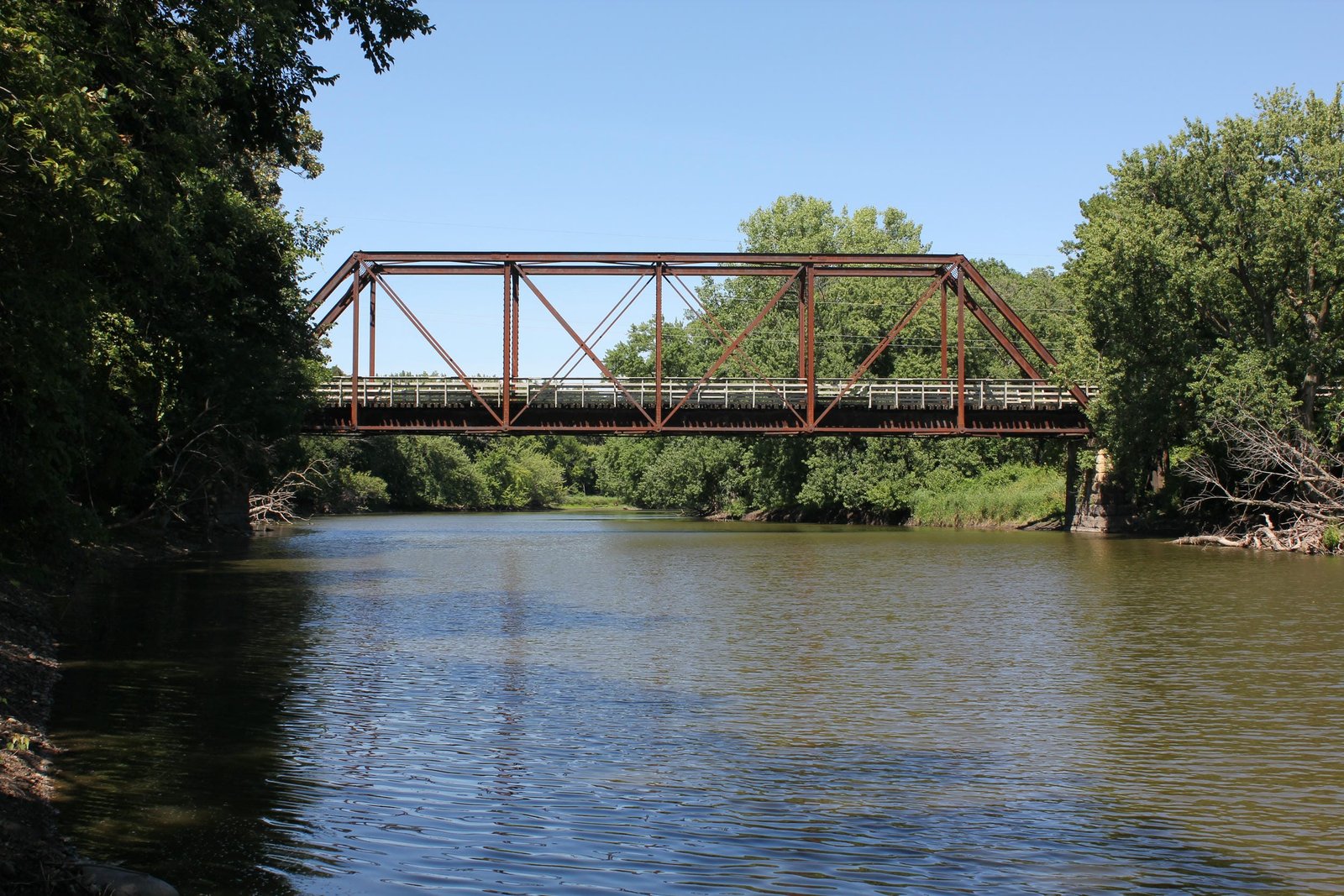
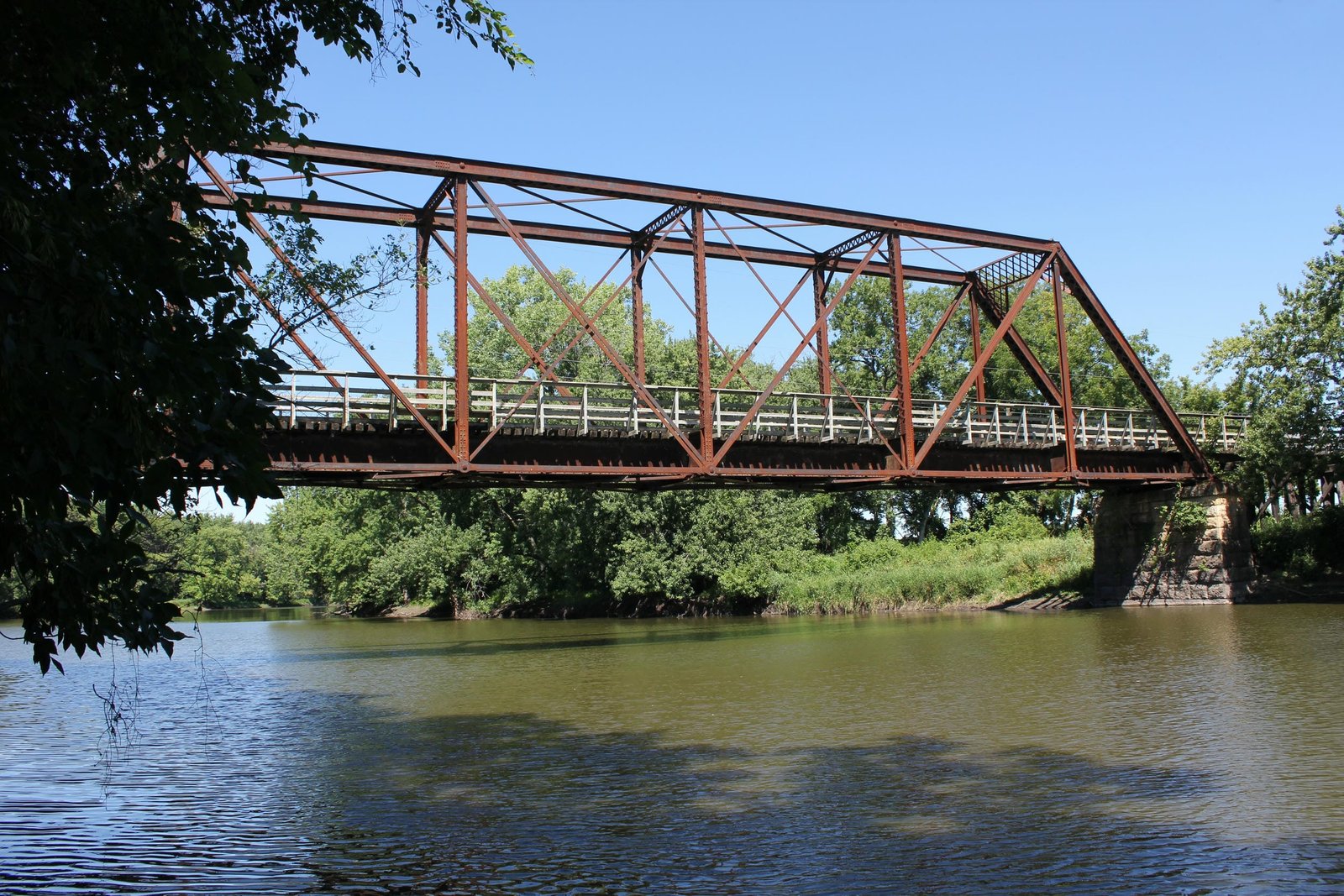
Located south of Humboldt in Frank Gotch State Park, this attractive Pratt through truss bridge carries a former Minneapolis & St. Louis Railway line over the East Fork Des Moines River. The first bridge at this location was likely a wooden truss bridge, set onto timber pile substructures and approached by timber pile trestle spans. In 1891, the first bridge was replaced by a 159-foot truss span, set onto stone piers and retaining the approach trestles on either end. Little is known about this bridge, although it is believed that the truss was also a wooden truss span. Between the late 1890s and early 20th Century, the M&StL made significant improvements to their lines, replacing wooden bridges with steel, stone and concrete structures. In 1901, the present bridge at this location was constructed. Currently, the bridge consists of a 159-foot, 6-panel, pin-connected Pratt through truss span, set onto stone piers. The east end (railroad south) is approached ten timber pile trestle spans, while the west end is approached by three timber pile trestle spans. Detroit Bridge & Iron Works fabricated the truss span, while the timber components were constructed by railroad company forces. The stone piers were reused from the 1891 bridge, and were constructed by an unknown contractor.
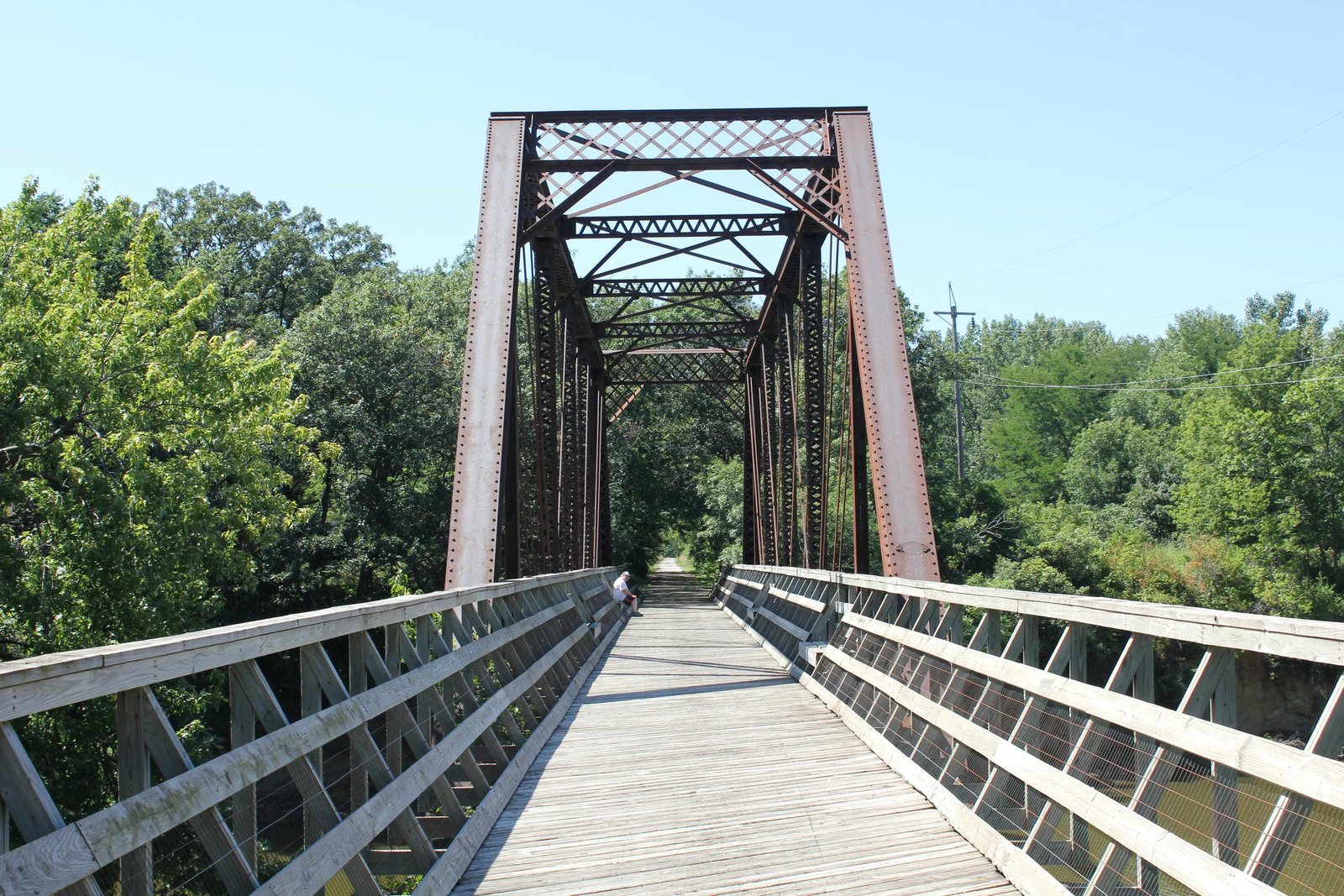
The truss span follows a standard pin-connected Pratt through truss design, with the addition of a decorative portal bracing. This span uses built-up members, a standard floor and an attractive lattice portal bracing. The bottom chord consists of eyebars, with one set at the outer panels and two sets at the inner panels. The vertical members consist of built-up beams, which are formed out of two U-shaped channels and conencted by a tight V-lacing. The diagonal members consist of eyebars, while the counters use slender steel rods with turnbuckles. The floor system follows a standard design, with two plate girder stringers and plate girder floorbeams. The portal bracing uses a deep lattice design, with triangular lattice heel bracings. The sway bracing is much more simple, with a V-laced beam and diagonal bars connecting to the vertical members. Both the upper and lower lateral bracing consist of square steel bars. The piers also follow a standard design, consisting of rectangular structures with an angled upstream nose. Stone for the piers consists of a tan limestone, quarried at an unknown location. The timber trestle approaches follow a standard M&StL design, with six stringers arranged into two sets of three. The timber components were likely last renewed in the mid-20th Century.
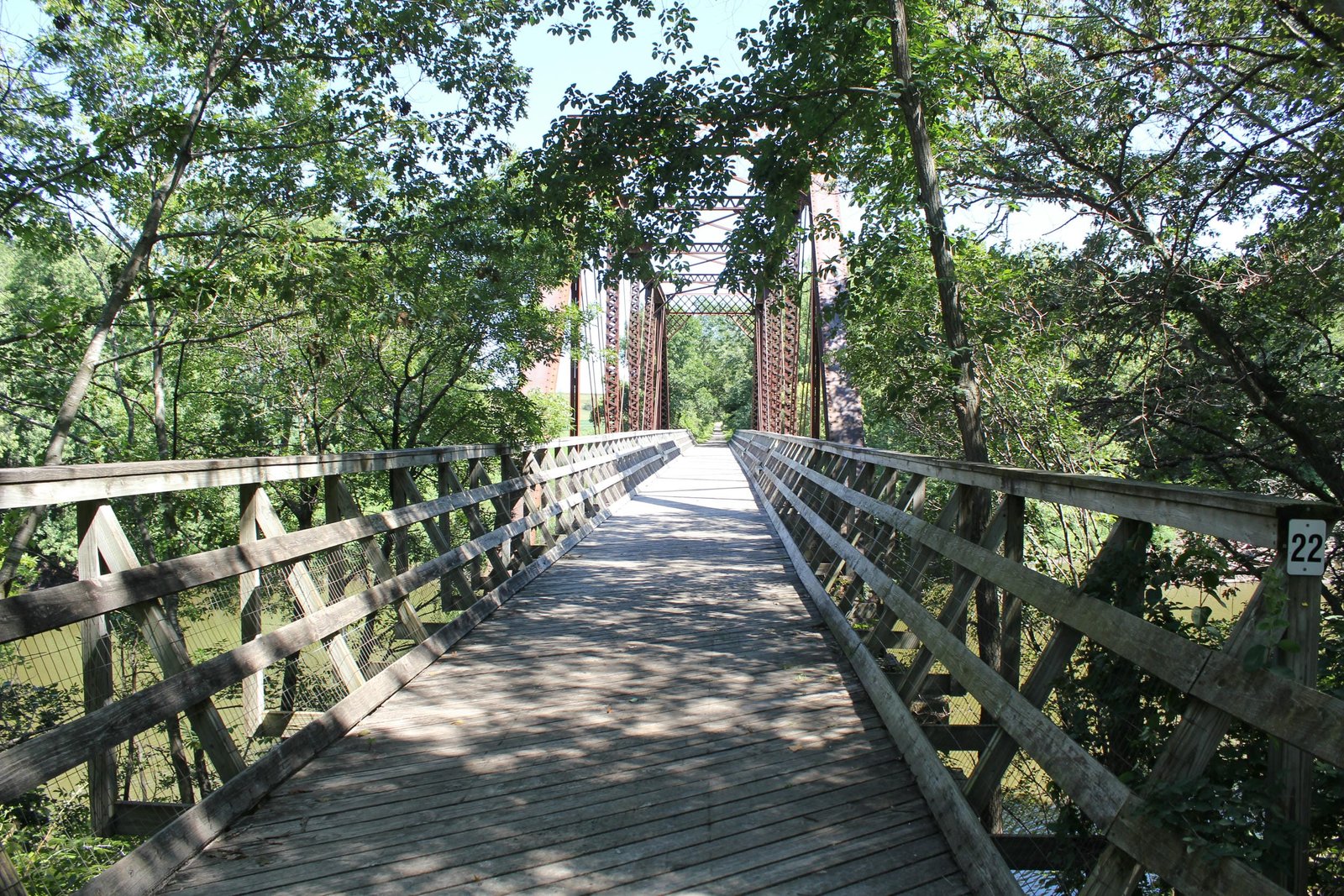
Pratt trusses were arguably the most common railroad truss bridge design during the second half of the 20th Century. This design was simple, economical and durable. By the turn of the 20th Century, railroads began switching to riveted Warren truss spans. The M&StL had relatively few truss spans on the system, and there was not a standard design followed. Out of the handful of through truss spans constructed prior to 1910, there was a number of both pin-connected Pratt spans and early riveted spans. Of the pin-connected Pratt spans, no two spans were identical, and each had slightly different features. Since the initial construction, the bridge has seen no significant alterations. After abandonment, the bridge was acquired by Humboldt County, and converted to trail use. A wooden deck and handrails were added, and the structure now serves a short segment of the Three Rivers Trail. Overall, the bridge appears to be in fair to good condition, with no significant deterioration noted. The author has ranked this bridge as being moderately significant, due to the truss design.
Citations
| Build date | Minneapolis & St. Louis Railway ICC Valuation Summary Report, courtesy Doug Harding collection |
| Builder (superstructure) | Missing Detroit Bridge & Iron Works plaque |
| Railroad History Citation | ICC Valuation Information, Compiled by Richard S. Steele |