
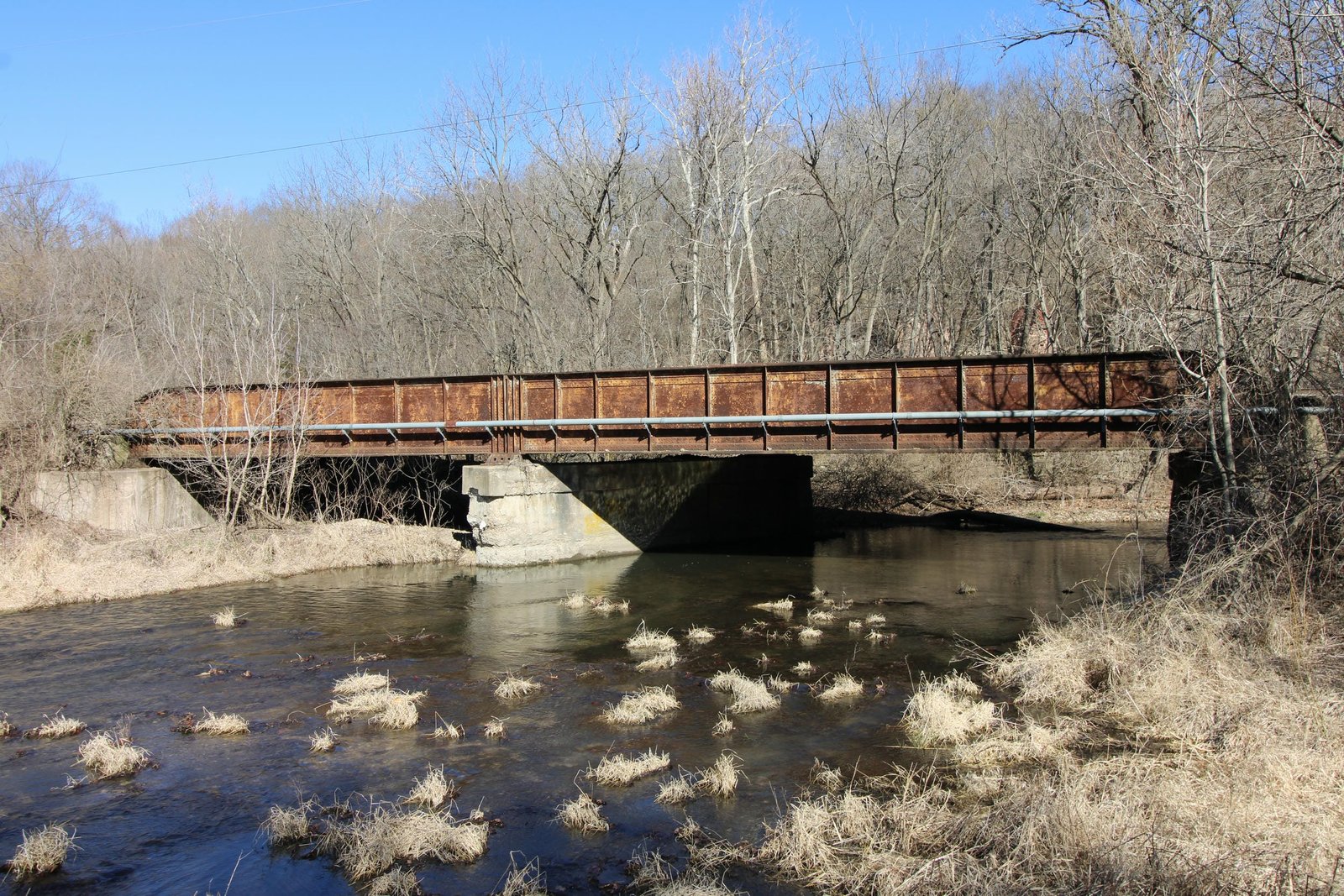


Click the photo to view the full-size version
| Name | IAIS Pecumsaugen Creek Bridge Chicago, Rock Island & Pacific Railway Bridge #960 |
| Built By | Chicago, Rock Island & Pacific Railway |
| Currently Owned By | Iowa Interstate Railroad |
| Superstructure Contractor | American Bridge Company of New York |
| Substructure Contractor | Unknown |
| Length | 103 Feet Total, 60 Foot Largest Span |
| Width | 2 Tracks, 1 In Use |
| Height Above Ground | 15 Feet (Estimated) |
| Superstructure Design | Through Plate Girder |
| Substructure Design | Concrete |
| Date Built | c. 1920 |
| Traffic Count | 5 Trains/Day (Estimated) |
| Current Status | In Use |
| Chicago, Rock Island & Pacific Railroad Bridge Number | 960 |
| Iowa Interstate Railroad Bridge Number | 960 |
| Significance | Local Significance |
| Documentation Date | 3/22/2025 |
In 1852, the Chicago and Rock Island Rail Road Company (C&RI) constructed 40 miles of new railroad, extending from Chicago, Illinois to Joliet, Illinois. The following year, the railroad constructed an additional 119 miles of new railroad to Geneseo, followed by an additional 22 miles to Rock Island, Illinois in 1854. Work was continued in 1856 by the Mississippi and Missouri Rail Road Company (M&M), which constructed a bridge across the Mississippi River to Davenport, Iowa and continued the line westwards across Iowa. In 1866, the two railroads were consolidated into the Chicago, Rock Island & Pacific Railroad, which was renamed the Chicago, Rock Island & Pacific Railway (Rock Island) in 1880. The line between Chicago and Joliet was double tracked prior to 1874, due to the heavy use. The Rock Island constructed and acquired a large network of railroads, primarily in Iowa during the late 1880s. This line served as a principal mainline for the railroad, connecting Chicago to the network of railroad lines west of the Mississippi River.
In approximately 1892, the remainder of the line would be double tracked, and in the late 1890s, additional tracks were added in Chicago. Track elevation projects within Chicago were made throughout the late 1890s and early 1900s. Throughout the 20th Century, the line continued to be a critical component of the Rock Island system. In 1913, the Rock Island elevated the line through Joliet. The Rock Island was a poor railroad, facing financial trouble regularly and often in bankruptcy. This route hosted passenger trains known as "Rockets" for many years, and the Rock Island offered a suburban commuter service over the line. After World War II, the Rock Island struggled to survive, proposing mergers and deferring maintenance on their routes. By 1964, the Rock Island began attempts to merge with Union Pacific, and restructure railroads west of the Mississippi River. This merger was eventually denied, and Rock Island turned its last profit in 1965.
In the mid-1970s, the
railroad was in serious decline. The railroad received loans to attempt
to fix slow orders, received new equipment and turn a profit. By 1978,
the railroad came close to profit, but creditors were lobbying for a
complete shutdown of the Rock Island. During the fall of 1979, a strike
crippled the railroad, and by January of 1980, the entire system was
ordered to be shut down and liquidated. Many of the lines and equipment
were scrapped. Profitable sections of railroad were prepared for
sale. Between Joliet and Chicago, the line would be sold to the Regional Transportation Authority. From Joliet to Utica, the line would be sold to the Chessie System, which became part of CSX Transportation in 1986. The portion from Utica into Iowa would be sold to the Iowa Interstate Railroad (IAIS). Today, the Chicago to Joliet segment is operated by Metra as the Rock Island District; CSX operates the line between Joliet and Utica as the New Rock Subdivision; and IAIS operates the Rock Island to Utica section as the Blue Island Subdivision.
Located between Utica and LaSalle, this through plate girder bridge carries the former Chicago, Rock Island & Pacific Railroad mainline across Pecumsaugan Creek. The first bridge at this location was likely a wooden truss bridge, constructed during the initial construction of the line by Boomer & Stone, which had the contract for all bridges on the Chicago to Rock Island line. The first bridge was likely replaced by another wooden truss bridge in the 1850s or 1860s, followed by the construction of a double track iron truss bridge in the 1880s. In approximately 1920, the bridge was replaced with the present bridge. Currently, the bridge consists of a 60-foot and a 43-foot through plate girder span, set onto concrete substructures. Each face of the bridge uses different span lengths, due to the heavy skew of the structure. The superstructure follows a unique design for the era, with heavy plate girders and a concrete ballast floor. The substructures use a standard Rock Island design, with a rectangular pier and U-shaped abutments. American Bridge Company fabricated the superstructure, while the substructure was constructed by an unknown contractor. Through plate girder spans were commonly used by railroads, as they were durable and easy to construct. Since the initial construction, the bridge has seen little alterations, and remains in use. Today, only the north track is in service, while the south track has been removed and the concrete deck exposed. Overall, the bridge appears to be in fair to good condition, with no significant deterioration noted. The author has ranked this bridge as being locally significant, due to the common design and unknown history.
Citations
| Railroad History Citation | ICC Valuation Information, Compiled by Richard S. Steele |