


Click the photo to view the full-size version
| Name | UP Bridge #53.90 Chicago & North Western Railway Bridge #264 |
| Built By | Chicago, St. Paul, Minneapolis & Omaha Railway |
| Currently Owned By | Union Pacific Railroad |
| Superstructure Contractor | Lassig Bridge & Iron Works of Chicago, Illinois |
| Substructure Contractor | Unknown |
| Length | 40 Feet Total |
| Width | 1 Track |
| Height Above Ground | 5 Feet (Estimated) |
| Superstructure Design | Deck Plate Girder |
| Substructure Design | Stone Masonry |
| Date Built | 1898 |
| Date Replaced | 2018 |
| Traffic Count | 0 Trains/Day (Bridge has been Replaced) |
| Current Status | Replaced by a new bridge |
| Chicago & North Western Railway Bridge Number | 264 |
| Union Pacific Railroad Bridge Number | 53.90 |
| Significance | Local Significance |
| Documentation Date | 6/26/2017 |
In 1865, the Minnesota Valley Railway Company (MVR) began construction on a new railroad line between Mendota, Minnesota and St. James, Minnesota. In 1865, the first 22 miles were completed between Mendota, Minnesota and Merriam Junction, Minnesota; followed by 17 additional miles to Belle Plaine, Minnesota in 1866. In 1867, the MVR completed an additional 16 miles to Le Sueur, Minnesota; followed by 12 additional miles to Kasota, Minnesota in 1868. In 1869, the MVR completed an additional 22 miles to Lake Crystal, Minnesota. The same year, an additional 5 miles would be completed between St. Paul, Minnesota and Mendota. In 1870, the MVR would be purchased by the St. Paul and Sioux City Railroad (StP&SC). 22 additional miles to St. James, Minnesota would be completed in 1870. The StP&SC completed 58 more miles from St. James to Worthington, Minnesota in 1871; and 64 additional miles to Le Mars, Iowa were completed in 1872. At Le Mars, the route connected to an existing railroad, over which the StP&SC used trackage rights to reach Sioux City, Iowa.
In 1881, the StP&SC would be sold to the Chicago, St. Paul, Minneapolis & Omaha Railway (Omaha Road). The Omaha Road would come under control of the Chicago & North Western Railway (C&NW) the next year. The C&NW had developed a large network of railroad lines in the Midwest, with the Omaha Road serving as the northern extent of the company. This route became the main line of the Western District of the Omaha Road. Several improvements were made to the line in the late 19th and early 20th Centuries. Between 1898 and 1906, several sections of the line were realigned between Blakeley, Minnesota and Mankato. In 1957, the C&NW leased the Omaha Road, and the C&NW purchased the company in 1972. The C&NW was purchased by Union Pacific Railroad (UP) in 1995. UP still operates the St. Paul to St. James segment as the Mankato Subdivision and the St. James to Sioux City segment as the Worthington Subdivision. The line remains a mainline for UP, connecting St. Paul to Sioux City and providing UP with a mainline into the Twin Cities.
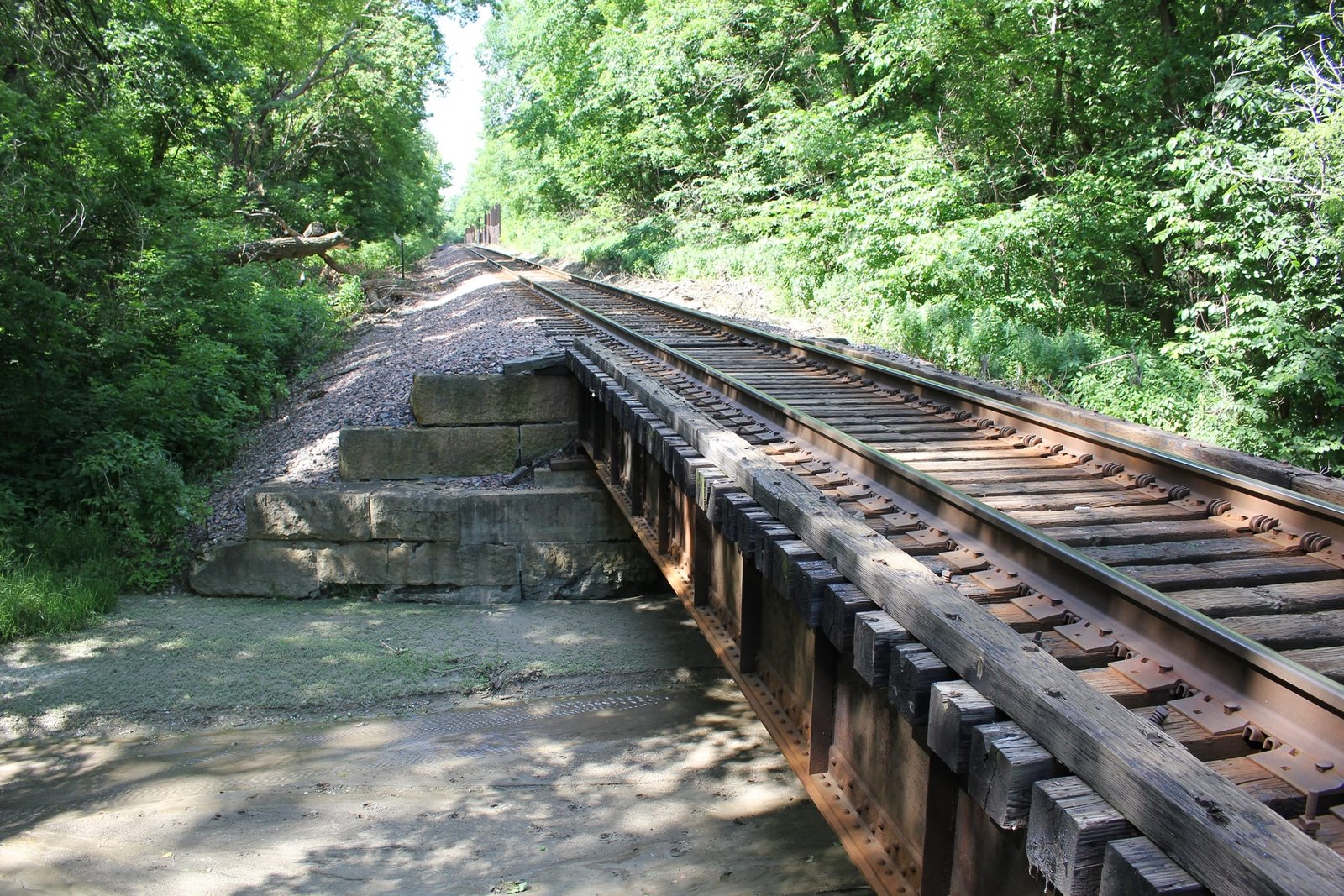
Located south of Blakeley, this small deck plate girder bridge once carried the former Chicago, St. Paul, Minneapolis & Omaha Railway (Omaha Road) mainline across an unnamed creek. The first bridge at this location was a 5-span timber pile trestle, located immediately west of this bridge. Between 1898 and 1902, the Omaha Road made significant improvements to the line between Blakeley and Le Sueur, realigning the railroad and replacing bridges. The bridge was with a steel structure in 1898 as part of that project. The bridge consisted of a single 40-foot deck plate girder span, set onto stone abutments. The superstructure followed a standard design, with medium-sized girders. However, the bridge may have been altered in the 20th Century with the addition of two additional girders. The substructures also used a standard design, with stepped wing walls extending perpendicularly from the bridge. Stone for the abutments consisted of a tan limestone, likely quarried at Mankato, Minnesota. Lassig Bridge & Iron Works fabricated the superstructure, and an unknown contractor constructed the abutments. Deck plate girder spans were commonly used by railroads, as they were durable and easy to construct. The bridge was replaced by a new concrete structure in 2018. Overall, the bridge appeared to be in fair condition at the time of documentation, with no significant deterioration noted. The author has ranked this bridge as being locally significant, due to the common design and unknown rebuild history.
Citations
| Build Date | Chicago, St. Paul, Minneapolis & Omaha Railway Valuation Notes located at the Chicago & North Western Historical Society Archives |
| Builders (superstructure) | Missing Lassig Bridge & Iron Works plaque |
| Railroad History Citation | ICC Valuation Information, Compiled by Richard S. Steele |